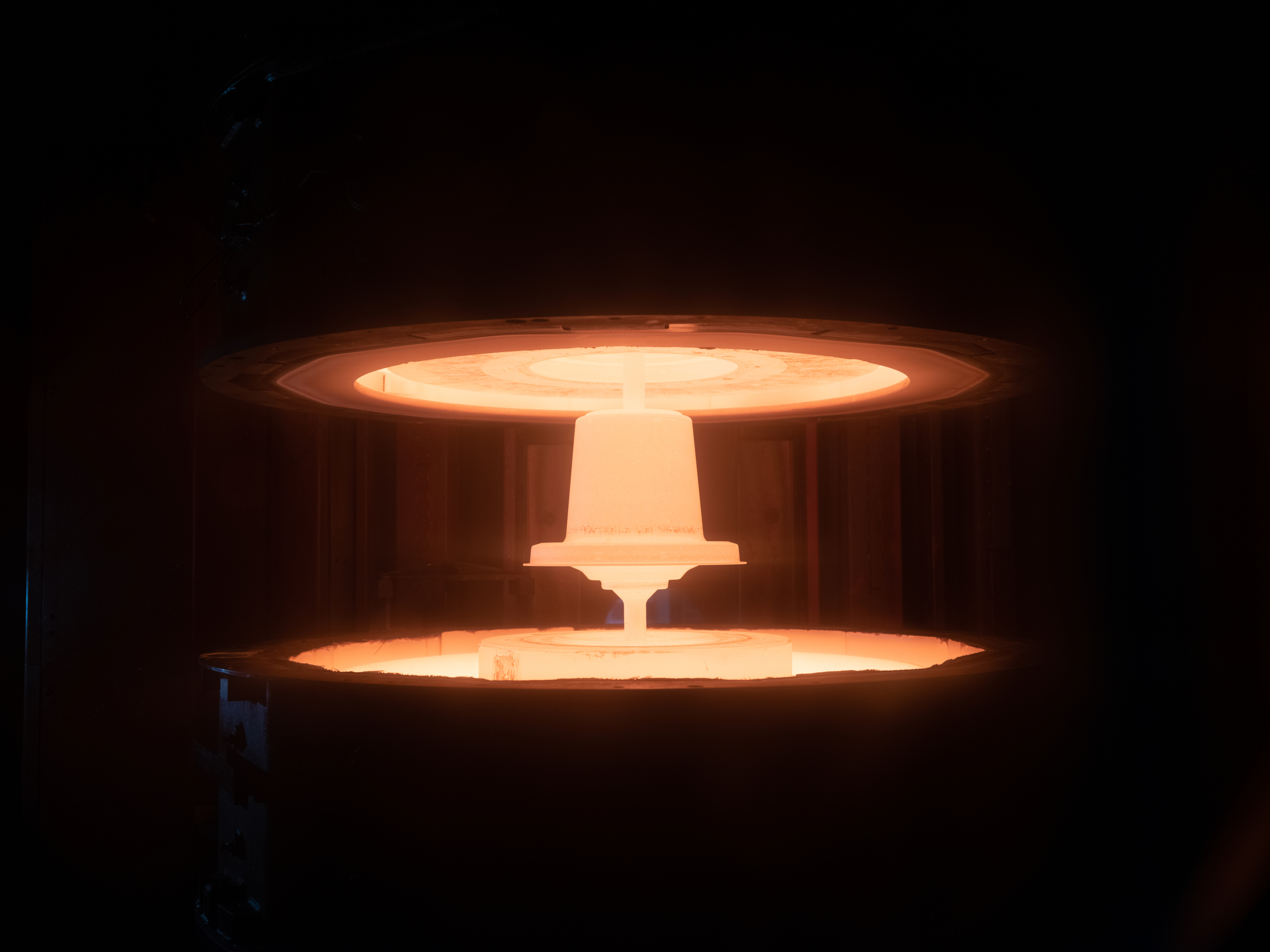
As temperatures, forces and operating demands rise beyond the limits of conventional metals, nickel superalloys keep performing. Engineered to retain strength under extreme heat, stress and corrosive environments, they're essential to some of the world's most demanding machines.
ATI operates at the leading edge of nickel metallurgy - developing and producing advanced cast-and-wrought and powder superalloys for jet engines, defense, specialty energy and space.
Strength That Doesn't Back Down From Heat
Nickel's defining advantage is not simply that it survives high temperatures. It's that carefully engineered nickel superalloys can retain the strength, creep resistance, fatigue performance and environmental resistance required to keep carrying load as temperatures climb.
That makes them indispensable when ordinary metals begin losing mechanical performance. The properties are extraordinary. Producing them consistently is even harder.
Strength at Temperature
Nickel superalloys retain exceptional mechanical strength at temperatures where many other structural metals lose capability. ATI's current website identifies alloys designed for service temperatures as high as 2,150°F.
Built for the Long Haul
Under sustained heat and load, metals can slowly deform - a phenomenon known as creep. Nickel superalloys are engineered to resist that deformation, helping critical components maintain their shape and performance over thousands of operating cycles.
Resistance in Hostile Environments
Heat is only part of the challenge. Nickel alloys can also provide outstanding oxidation and corrosion resistance for applications ranging from hot-section engine components to energy and oil & gas equipment.
The Harder the Alloy, the Stronger Our Advantage.
Adding more alloying elements can increase temperature capability and strength - but it also makes nickel superalloys progressively harder to melt, solidify and work without defects. ATI specializes at that difficult end of the spectrum. We control chemistry, microstructure and processing from melt through billet, powder and finished product forms to produce some of the world's most demanding nickel superalloys.
Purity From the Start.
ATI combines Vacuum Induction Melting, Electroslag Remelting and Vacuum Arc Remelting to precisely control chemistry, inclusions and segregation. For the most demanding rotating applications, multiple melt steps produce premium-quality material with the consistency and inspectability required when failure isn't an option.
We Make the Alloys Others Can't
As nickel superalloys become stronger and more highly alloyed, they also become more difficult to manufacture. That's where ATI excels.
ATI is a leader in premium-quality nickel and some of the industry's most difficult-to-produce alloys, combining advanced melting with the hot-working capabilities required to turn challenging chemistries into production-scale material.
From Melt to Microstructure
Making the chemistry is only the beginning.
ATI controls the thermomechanical processing that transforms an ingot into high-performance material. Homogenization, press forging, radial forging, rolling and heat treatment refine grain structure and develop the properties engineered into the alloy.
Powder Changes the Possibilities
Some of the most demanding next-generation alloys perform even better when conventional casting gives way to powder metallurgy.
ATI controls powder production from atomization through screening, blending and Hot Isostatic Press, producing highly homogeneous material for critical rotating components and additive applications.
ATI identifies powder advantages including homogeneous microstructure, enhanced inspectability and improved high-temperature performance.
The ATI Nickel Superalloy Portfolio
Engineering the Next Degree of Performance
Some alloys carry the ATI name. Others were developed with our customers. What they share is the metallurgy and manufacturing expertise required to move increasingly demanding chemistries from development into production.
ATI 718™
A precipitation-hardened nickel superalloy combining high strength, oxidation resistance and manufacturability. Its balance of properties has made 718 a foundational material for aerospace, energy and other demanding applications. ATI 718 maintains high strength to approximately 1,400°F and oxidation resistance to approximately 1,800°F.
- Engine Disks
- Rings & Cases
- Shafts
- Fasteners
- Energy Equipment
ATI 718Plus™
Developed by ATI to extend the temperature capability of 718 while retaining much of its manufacturability, ATI 718Plus® delivers higher-temperature strength and thermal stability for increasingly demanding engine applications. ATI 718Plus demonstrates an approximately 100°F operating-temperature advantage over 718, while maintaining favorable processing characteristics.
- Turbine Disks
- Compressor Components
- Rings
- Cases
- Other High-Temperature Components
ATI 720™
A high-strength nickel superalloy engineered for critical rotating components where exceptional fatigue and elevated-temperature performance are required. ATI's ability to melt and hot-work alloys at this level of complexity is a key part of our premium-quality nickel leadership.
- Jet-Engine Disks
- Other High-Strength Rotating Components
R65
A highly advanced cast-and-wrought nickel superalloy for next-generation jet-engine rotating components. ATI's melt and conversion capabilities enable production of this difficult-to-manufacture alloy at the quality and scale required for flight-critical applications.
Next-Generation Engine Disks & Rotating Components
Powder Superalloys
When conventional cast-and-wrought metallurgy reaches its limits, powder metallurgy opens another performance frontier. ATI produces advanced nickel powders engineered for extremely fine, uniform microstructures and the demanding temperature, fatigue and durability requirements of next-generation engine disks.
- High-Pressure Turbine Disks
- Compressor Disks
- Next-Generation Rotating Components
Where Nickel Superalloys Perform
Learn More About Our Materials
Learn more about our materials.
See Nickel Superalloys Data Sheets