
Hafnium
Hafnium starts in the same mineral as zirconium - and separating the two is extraordinarily difficult. But once isolated and purified, hafnium becomes a remarkable material in its own right, bringing unique thermal, chemical and nuclear properties to some of the world’s most advanced technologies.
ATI combines specialized chemical separation with high-purity refining and downstream materials expertise to produce hafnium at production scale for semiconductors, aerospace, defense, space and other demanding applications.
Learn More About Hafnium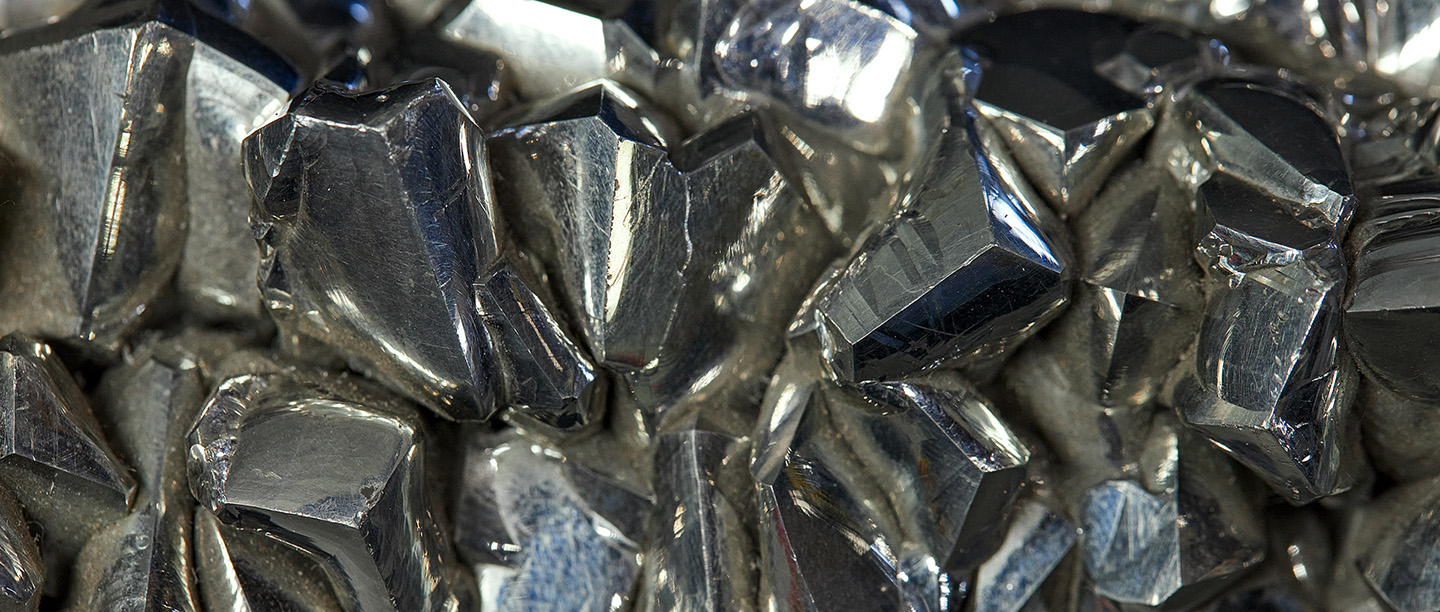
Hafnium Alloys
Wire: Size Range IN (mm): 0.0700 – 0.2499 in. (1.7 – 6.3mm) Min Qty LBS (Kg): 5 (2.2Kg)
A white, free flowing, anhydrous powder. This compound reacts immediately with water and water vapor to release hydrochloric acid fumes. Avoid personal contact. Store in a cool, dry area.
ATI produces hafnium powder as per the general capabilities mentioned previously. The purities available are suited for either commercial or nuclear applications. Nuclear grade can be used to produce rate-control parts and various apparatus in nuclear electrical power generators as well as applications in nuclear fuel processing. Commercial grade forms a basis for various chemicals, sputtering targets, pyrotechnical applications, plasma spray coatings, and alloy additions. The table below gives a TYPICAL chemical analysis based upon nominal mesh sizes stated. Please refer to general powder capabilities and testing.
Hafnium is a heavy, steel-gray metal in the reactive metals group that is very closely related to zirconium, and forms a continuous solid-solution at all concentrations of zirconium and hafnium. Hafnium occurs naturally with zirconium at a ratio of approximately 1:50, and is produced exclusively as a co-product of nuclear-grade zirconium. It is used in a variety of applications where few substitutes are available.
Hafnium and zirconium have nearly opposite nuclear properties; thus with its relatively high thermal neutron cross-section, hafnium’s biggest application is as control rod material in nuclear reactors. In this application, the presence of a few percent of zirconium (< 4.5%) does not adversely affect its performance.
When used in relatively small amounts, hafnium strengthens the grain boundaries of nickel-based super-alloys and high temperature alloys, improving the creep ductility and rupture lifetime. It is extensively used in a number of alloys that find use in the hot end of jet engines. Hafnium has an extremely high affinity for oxygen, nitrogen, and carbon, and is one of the most effective solid-solution strengtheners via dispersion strengthening.
Like the other reactive metals, hafnium is HCP (Hexagonal Close-packed) at room temperature and anisotropic. Even more than zirconium or titanium, the mechanical properties of hafnium are affected by interstitial element contamination. In many applications, a very low interstitial content may be necessary to obtain the required ductility or other properties. For such critical applications, the iodide crystal bar process is used by ATI to produce hafnium with a typical oxygen concentration of 60 ppm or less.
Hafnium is also used extensively as a tip insert for plasma welding tips. With a low work function and a high melting point, hafnium has been found to extend the life of plasma welding tips, and to give better performance.
Its behavior in corrosive media is very similar to that of zirconium, and in the absence of data can be considered to be roughly equivalent. The general applications include: nuclear reactor control rods, neutron absorption, alloy additive in various superalloys, plasma torch welding tips. Hafnium is available in common mill forms including plate, sheet, foil, rod, and wire.
Hafnium metal is also available in a number of forms for alloying. For higher purity applications, where very low oxygen and nitrogen content are especially critical, crystal bar is produced with typical oxygen content of less than 60ppm. It is available in chunk form (chopped bars), whole bars, or milled chips. Where crystal bar chemistry is desired, but for less critical applications, tip material is available as unqualified crystal bar. Hafnium sponge is also available for standard alloying needs.
Hafnium powder is produced at ATI, and is also available in standard mesh sizes ranging from 80 – 325 mesh x down.
Hafnium sponge is normally provided in a minus 3/4 plus 1/8 MESH Size. Other sizes are available by request. Hafnium sponge is available in three grades as determined by Zr content: < 1/2% Zr, < 1.5% (medium grade) Zr, and < 4.5% Zr (reactor grade).
Hafnium crystal bar is provided in nominal size diameters 1"– 3" X 24"– 36" random lengths. It is also available chopped to nominal 1"– 2" lengths (shorter lengths are available), and as milled chips, nominal 0.100" wide X 0.500" long.